The NIST AI RMF for Generative AI: How LLM Firewalls Support Compliance
The NIST AI Risk Management Framework (AI RMF) is the most widely adopted government framework for AI governance. In July 2024, NIST published the Generative AI Profile (NIST-AI-600-1), which identifies risks specific to generative AI and proposes actions for managing them.
For compliance officers, risk teams, and CISOs, the question is practical: how do the controls in an LLM firewall map to the NIST AI RMF functions? This article provides that crosswalk.
The NIST AI RMF structure
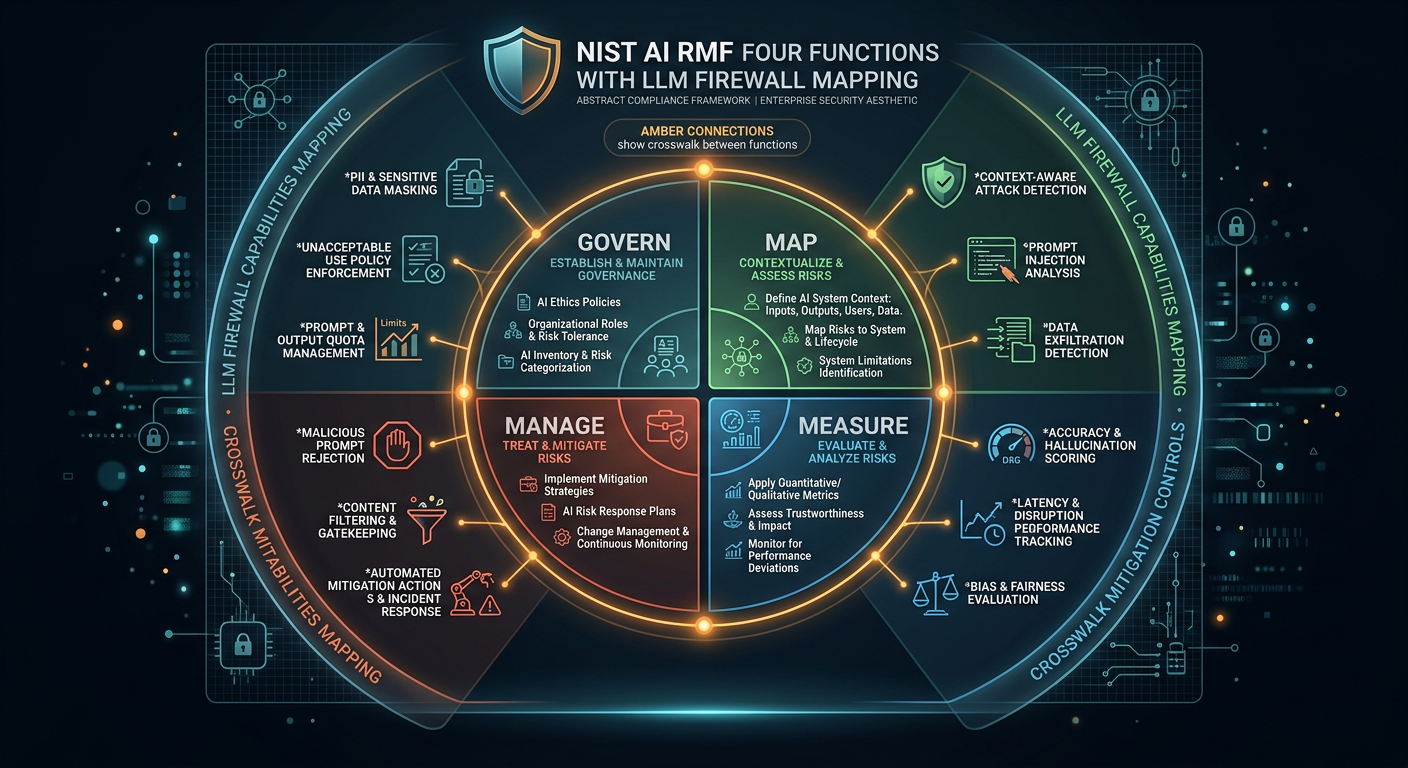
The AI RMF organizes risk management into four functions:
- Govern: Establish policies, processes, and accountability for AI risk
- Map: Identify and contextualize AI risks
- Measure: Assess and quantify AI risks
- Manage: Prioritize and act on AI risks
The Generative AI Profile extends this with specific risks like data poisoning, prompt injection, sensitive information disclosure, and model theft. Each risk maps to one or more of the four functions.
How an LLM firewall supports each function
Govern: Policy establishment and accountability
The Govern function is about defining who is responsible for AI risk and what policies govern AI use. An LLM firewall supports this by providing the enforcement mechanism for policies that would otherwise be aspirational documents.
NIST Govern subcategories the firewall supports:
Govern 1.1: Legal, regulatory, and ethical requirements are understood and managed. The firewall enforces data classification policies that map to regulatory requirements (GDPR, HIPAA, GLBA, CCPA). Policies are configurable per data type and per user role.
Govern 1.3: Processes and procedures are defined for managing risks. The firewall provides the technical control that operationalizes risk management procedures. A policy that says "customer data must not enter AI systems" becomes enforceable through prompt redaction rules.
Govern 2.1: Roles and responsibilities are documented. The firewall supports role-based policies: different user roles have different inspection rules, redaction policies, and access boundaries.
Govern 4.1: Organizational practices are aligned with policies. The firewall provides audit logs that demonstrate whether AI usage complies with organizational policies. These logs serve as evidence for internal audits and regulatory reviews.
What the firewall provides for Govern:
- Configurable policy engine for data classification, injection detection, and exfiltration prevention
- Role-based policy enforcement
- Audit logging for compliance evidence
- Policy versioning and change tracking
Map: Risk identification and contextualization
The Map function is about understanding what AI risks exist in your environment and how they relate to your specific context. An LLM firewall supports this by providing visibility into AI traffic that was previously invisible.
NIST Map subcategories the firewall supports:
Map 1.1: Context is established for the AI system. The firewall inventories all AI channels in the environment: copilots, coding agents, custom applications, and shadow AI. Each channel's traffic is inspected and categorized.
Map 1.5: Impacts to third parties are identified. The firewall detects when AI interactions involve third-party data (customer data, partner data, vendor data) and flags potential impacts.
Map 2.2: Security risks are identified. The firewall identifies specific risks in real time: prompt injection attempts, sensitive data in prompts, exfiltration patterns, and tool-use anomalies. These findings feed into the organization's risk register.
Map 3.1: Risk tracking is established. The firewall logs every AI interaction with metadata: user, channel, data classification, risk score, and policy actions taken. This creates a historical record for risk tracking.
What the firewall provides for Map:
- AI traffic inventory and categorization
- Real-time risk identification across all AI channels
- Risk scoring per interaction and per session
- Historical logging for risk tracking and trend analysis
Measure: Risk assessment and quantification
The Measure function is about assessing and quantifying AI risks. An LLM firewall supports this by providing measurable data on AI security events.
NIST Measure subcategories the firewall supports:
Measure 1.1: Appropriate methodologies are selected to assess AI risks. The firewall provides multiple measurement methodologies: pattern-based detection (known attack signatures), semantic analysis (content inspection), behavioral analysis (anomaly detection), and cumulative tracking (session-level pattern analysis).
Measure 1.2: AI system reliability and validity are assessed. The firewall monitors model behavior over time, detecting behavioral anomalies that may indicate poisoning, manipulation, or degradation.
Measure 2.1: Data and AI system performance are documented. The firewall logs interaction metrics: prompt volume, response content classification, policy violation rates, exfiltration risk scores, and tool-use patterns. These metrics document AI system performance from a security perspective.
Measure 2.3: Measured effects are documented. The firewall produces reports on security events: injection attempts detected, sensitive data redacted, exfiltration patterns flagged, and tool-use anomalies caught. These reports serve as documentation for audits and risk assessments.
What the firewall provides for Measure:
- Quantitative risk scoring per interaction, session, and user
- Behavioral anomaly detection for model performance monitoring
- Security event reporting with metrics and trends
- Audit-ready documentation of all AI security events
Manage: Risk prioritization and response
The Manage function is about acting on identified risks. An LLM firewall supports this by providing real-time controls that prevent risks from materializing into incidents.
NIST Manage subcategories the firewall supports:
Manage 1.1: AI risks are prioritized and responded to. The firewall prioritizes risks in real time using exfiltration scoring. High-risk interactions are blocked or flagged; low-risk interactions are logged. This prioritization is automated and consistent.
Manage 2.1: Resources are allocated to manage risks. The firewall reduces the manual effort required to manage AI security risks. Automated redaction, blocking, and alerting mean security teams focus on investigating flagged events rather than reviewing all AI traffic manually.
Manage 2.3: Third-party risks are managed. The firewall validates that AI traffic goes only to approved model providers, tracing backends, and tool endpoints. Third-party risks from supply chain vulnerabilities (like the AI gateway compromise in July 2026) are mitigated by content inspection even when the intermediary is compromised.
Manage 3.1: AI risks are treated and accepted. The firewall provides the control layer for risk treatment: redaction (mitigation), blocking (avoidance), alerting (transfer to security team), and logging (acceptance with monitoring). Each treatment is documented for audit purposes.
What the firewall provides for Manage:
- Real-time risk treatment through redaction, blocking, and alerting
- Automated prioritization based on exfiltration scoring
- Third-party risk mitigation through endpoint validation
- Documented risk treatment decisions for audit trails
The crosswalk summary
| NIST AI RMF Function | Firewall Capability | Compliance Value |
|---|---|---|
| Govern 1.1: Legal/regulatory requirements | Data classification policy engine | Demonstrates enforceable controls for GDPR, HIPAA, GLBA |
| Govern 1.3: Processes for managing risk | Policy enforcement layer | Translates risk procedures into technical controls |
| Govern 2.1: Roles and responsibilities | Role-based policy enforcement | Shows accountability through access controls |
| Govern 4.1: Practices aligned with policies | Audit logging | Evidence for internal and regulatory audits |
| Map 1.1: Context for AI systems | AI traffic inventory | Documents all AI channels and their risk profiles |
| Map 2.2: Security risks identified | Real-time threat detection | Identifies injection, exfiltration, and tool-use risks |
| Map 3.1: Risk tracking | Historical logging | Creates auditable record of all AI security events |
| Measure 1.1: Assessment methodologies | Multi-method detection | Pattern, semantic, behavioral, and cumulative analysis |
| Measure 2.1: Performance documented | Security metrics and reporting | Quantifies AI security posture over time |
| Measure 2.3: Effects documented | Security event reports | Audit-ready documentation |
| Manage 1.1: Risks prioritized | Exfiltration scoring | Automated risk prioritization in real time |
| Manage 2.1: Resources allocated | Automated controls | Reduces manual review burden |
| Manage 2.3: Third-party risks managed | Endpoint validation | Mitigates supply chain risks |
| Manage 3.1: Risks treated | Redaction, blocking, alerting | Documented risk treatment decisions |
Why this matters for compliance
Organizations adopting the NIST AI RMF need to demonstrate that their AI governance is not just documented but operationalized. A policy document that says "sensitive data must not be disclosed through AI systems" is governance on paper. A firewall that inspects every AI response for sensitive data and redacts it before it reaches the user is governance in practice.
The NIST Generative AI Profile specifically calls out risks that an LLM firewall addresses:
- Data poisoning: The firewall detects behavioral symptoms of poisoned models
- Prompt injection: The firewall detects and blocks injection attempts
- Sensitive information disclosure: The firewall inspects and redacts responses
- Model theft: The firewall detects extraction patterns and rate-limits probing
- Supply chain vulnerabilities: The firewall validates endpoints and monitors traffic
- Insecure plugin design: The firewall inspects tool calls and enforces allow-lists
- Excessive agency: The firewall monitors tool use and enforces boundaries
For organizations that need to demonstrate compliance with the NIST AI RMF, an LLM firewall provides the technical controls that make the framework operational. Without it, the framework is a set of policies. With it, those policies are enforced.
How Milgram supports NIST AI RMF compliance
Milgram maps directly to all four NIST AI RMF functions:
- Govern: Configurable policy engine, role-based enforcement, audit logging
- Map: AI traffic inventory, real-time risk identification, historical logging
- Measure: Multi-method detection, security metrics, audit-ready reporting
- Manage: Real-time risk treatment, automated prioritization, endpoint validation
For compliance officers, this means Milgram is not just a security tool. It is a governance enforcement layer that makes the NIST AI RMF actionable. Policies become controls. Risks become measurable. Treatment becomes documented.
Bottom line
The NIST AI RMF defines what good AI governance looks like. An LLM firewall makes it operational. The crosswalk above shows how each NIST function maps to concrete firewall capabilities.
If your organization is adopting the NIST AI RMF and you need an AI data protection platform that demonstrates compliance, the firewall is the layer that turns governance documents into enforced controls. That is what secure generative AI integration requires: not just policies, but the technical controls that enforce them.
Milgram was built to be that layer. It maps to the NIST AI RMF functions and provides the evidence, enforcement, and reporting that compliance teams need.